Understanding Dysgraphia-Like Patterns Without a Label
Some children show writing patterns that look dysgraphia-like, even without a formal diagnosis. Parents can still observe, support, and seek clarity without rushing to label.
June 2, 2026
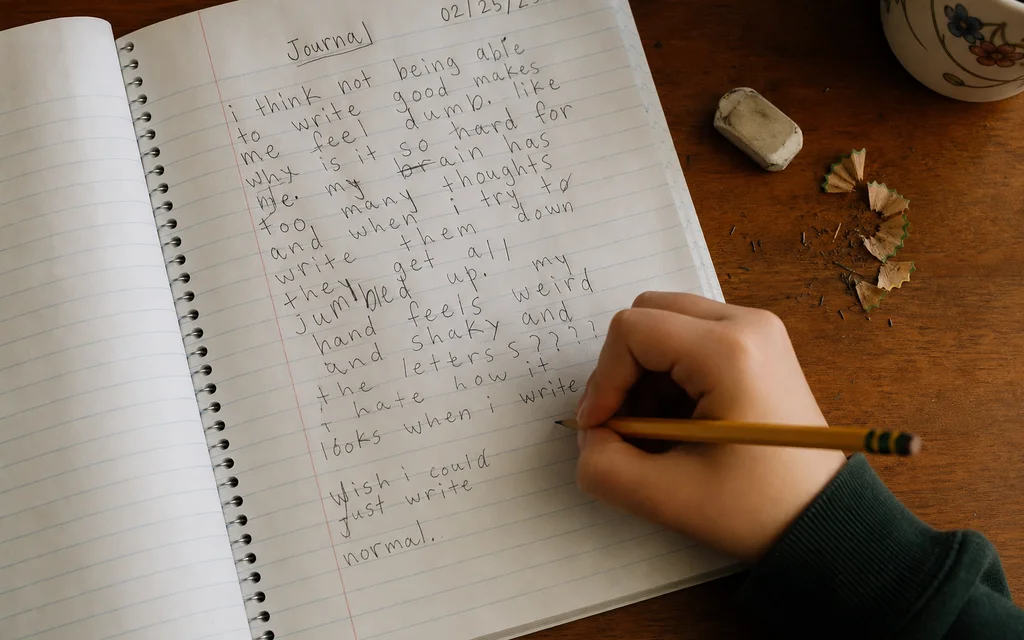
Some children show writing patterns that look dysgraphia-like, even without a formal diagnosis. Parents can still observe, support, and seek clarity without rushing to label.
June 2, 2026
Parents often arrive at the word dysgraphia after months or years of confusion.
They notice the messy writing. The slow output. The hand fatigue. The short answers from a child who has much more to say. They search online. They compare symptoms. They wonder if this is the word that explains what they have been seeing.
Sometimes a label is helpful. A formal diagnosis can open doors to accommodations, services, and better understanding. But not every family has a label. Not every child fits neatly into one category. And not every parent is ready to start there.
You can still notice dysgraphia-like patterns without diagnosing your child.
The phrase “dysgraphia-like” can be useful because it keeps the focus on observation. It says: something about writing is harder than expected, and we should look more carefully.
That is different from deciding exactly what the child has.
Writing is a complex task. A child may struggle with handwriting, spelling, written expression, spacing, organization, stamina, or the ability to get thoughts onto paper. Some children struggle mainly with the motor side of writing. Others struggle with language, sequencing, spelling, or confidence. Many show a mix.
From the outside, these patterns can look similar.
Parents may notice:
None of these signs alone proves a diagnosis. But together, they can help parents explain what they are seeing.
This matters because children with writing struggles are often misunderstood. They may be called careless when they are overwhelmed. They may be told to try harder when they are already using enormous effort. They may be treated as unmotivated when the task is genuinely difficult.
A label is not the only way to begin helping.
You can start by gathering examples. Keep a few writing samples from different days. Notice when writing is better or worse. Compare copied work, original writing, spelling, and oral answers. Pay attention to fatigue. Watch whether your child forms letters consistently or seems to reinvent them.
You can also change the way you speak about the struggle.
Instead of: “Your writing is so messy.”
Try: “I can see writing is taking a lot of effort. Let’s figure out which part is hardest.”
Instead of: “You just need to slow down.”
Try: “Does your hand feel like it can keep up with your idea?”
The goal is not to lower expectations. The goal is to understand what kind of support makes expectations reachable.
At Alphabetter, we work with families who may or may not have formal labels. We look at the patterns underneath writing: letter formation, alphabet confidence, sequencing, recall, stamina, expression, and the emotional experience of writing.
If a family needs formal evaluation, that may be an important step. Alphabetter is not a replacement for medical, psychological, or educational diagnosis. But many families also need practical clarity about what they are seeing at home every day.
You do not need to wait until everything has a name before you take your child’s struggle seriously.
A label can be useful. But observation is powerful too.
When parents begin with careful observation instead of blame, the child is no longer “messy,” “lazy,” or “difficult.” They are a learner with a pattern worth understanding.
That is a much better place to start.
— Diane Devenyi, JD, MEd
Book a private consultation or explore the Hidden Genius Literacy Assessment.