Spelling Lists Aren't the Problem — Letter Uncertainty Might Be
Spelling lists are not automatically bad. But when a child keeps forgetting, guessing, or spelling inconsistently, the issue may be deeper than weekly practice.
June 2, 2026
Spelling lists are not automatically bad. But when a child keeps forgetting, guessing, or spelling inconsistently, the issue may be deeper than weekly practice.
June 2, 2026
Spelling lists are familiar.
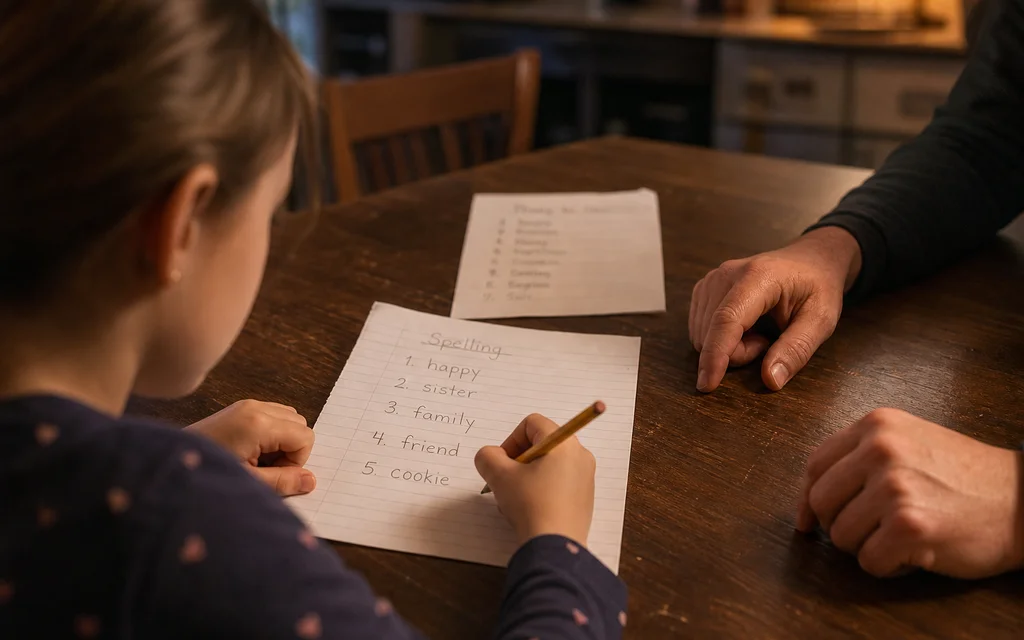
The words come home on Monday. The test happens on Friday. Somewhere in between, there is copying, quizzing, maybe flashcards, maybe a few tears at the kitchen table.
For some children, spelling lists work well enough. They study the words, remember them, and gradually build a stronger spelling vocabulary.
For other children, the cycle feels strangely temporary.
They learn the words for the test, then lose them. They spell a word correctly in isolation, then incorrectly in a sentence. They practise with you one night and seem to have it, then guess the next morning.
When this happens, the spelling list is not necessarily the problem. But it may not be reaching the real problem either.
The real issue may be letter uncertainty.
Letter uncertainty can show up in different ways. A child may know the alphabet song but still be unsure of letter direction, formation, sequence, sounds, or recall. They may recognize letters in one context but struggle to use them automatically when writing. They may know a sound but hesitate over which letter or letter pattern represents it. They may spell by memory and guessing rather than by a stable internal system.
This matters because spelling depends on more than seeing a word repeatedly.
A child needs to understand how letters work inside words. They need to hear sounds, map them to symbols, hold them in sequence, and write them in order. If the letters themselves are not fully secure, spelling becomes much harder to stabilize.
That is why a child may seem to “know” a word one day and lose it the next. The word was memorized, but not anchored.
Parents often describe this as guessing. The child tries one version, looks at it, tries another, and waits for someone to confirm. Sometimes they spell phonetically. Sometimes they leave out vowels. Sometimes they mix up the order. Sometimes they know the first sound but cannot hold the whole word.
This can become exhausting for everyone.
The parent thinks, “We just practised this.” The child thinks, “I can’t do this.” The homework gets longer. Confidence gets smaller.
More spelling lists may not solve that kind of uncertainty. In some cases, they simply add more words to a shaky system.
This does not mean spelling practice should disappear. It means practice needs a stronger foundation. Before asking a child to memorize more words, it may help to understand how they are working with letters in the first place.
Parents can watch for:
These are not reasons to panic. They are reasons to look more carefully.
At Alphabetter, we look at spelling through the lens of alphabet ownership. Does the child feel confident with letter names, sounds, shapes, sequence, direction, formation, and recall? Can they access those patterns while writing? Or is too much energy going into uncertainty before the word even begins?
When letter confidence improves, spelling practice can become less random. The child has more to rely on than memory alone. They can begin to notice patterns, trust their choices, and understand why words are built the way they are.
Spelling lists are not the enemy. But for some children, they are not enough.
If the foundation underneath spelling is uncertain, the next step may not be a longer list. It may be a closer look at the letters themselves.
— Diane Devenyi, JD, MEd
Book a private consultation or explore the Hidden Genius Literacy Assessment.