Why Spelling Stays Inconsistent After Years of Practice
Some children practise spelling for years and still spell the same word different ways. When spelling does not stick, it may be time to look below memorization.
June 2, 2026
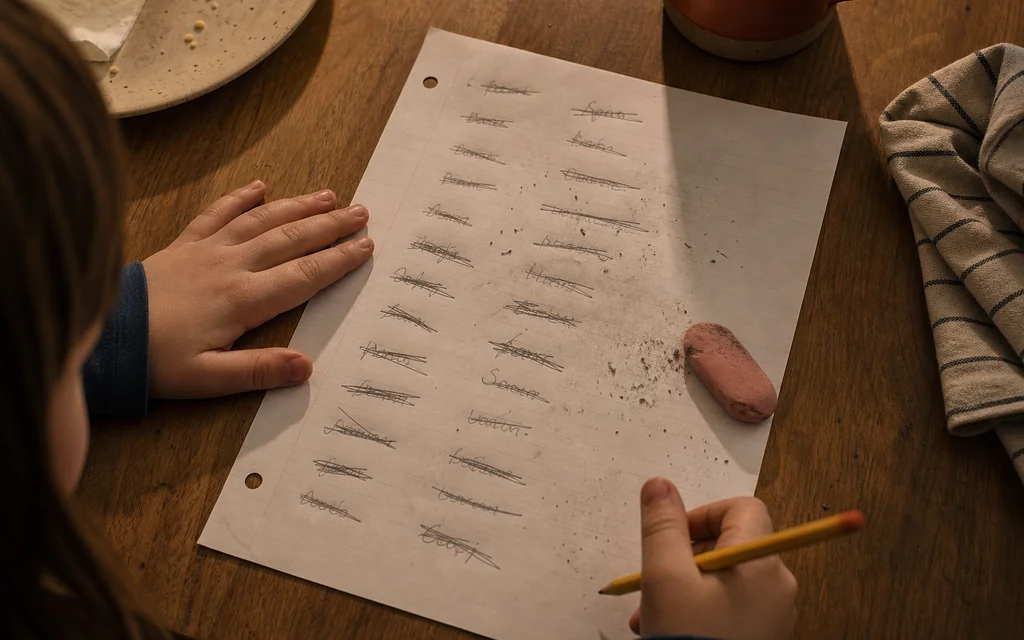
Some children practise spelling for years and still spell the same word different ways. When spelling does not stick, it may be time to look below memorization.
June 2, 2026
Inconsistent spelling can make parents feel like they are going in circles.
Your child studies the list. They practise the words. They may even get them right on Friday. Then the same words appear in a sentence the next week, and everything falls apart.
Because. Becuz. Becaus. Beacuse.
The word was learned. Then it seemed to disappear.
It is easy to assume the child did not practise enough, was not paying attention, or simply needs more repetition. Sometimes practice helps. But when spelling stays inconsistent after years of practice, the problem may not be the amount of effort. It may be the kind of foundation the practice is sitting on.
Spelling is not only memory.
Good spelling depends on many systems working together. A child needs to hear the sounds in a word, connect those sounds to letters and patterns, remember how the word looks, understand its structure, and write it automatically enough to use it in real sentences.
A spelling list can test whether a child can hold a word briefly. It does not always show whether the spelling pattern has become stable.
That is why some children can do well on spelling tests but struggle in everyday writing. On the test, the word is isolated. The child is focused only on spelling. In a sentence or paragraph, the child has to think about ideas, grammar, punctuation, handwriting, organization, and spelling at the same time.
If spelling is not automatic, it becomes one more thing competing for attention.
Children with inconsistent spelling may rely heavily on memorization. They may remember words as shapes or temporary images rather than understanding the relationships between sounds, letters, sequence, and patterns. This can work for a short time, especially with weekly lists. But it often breaks down when there are too many words, too much writing, or not enough context.
Parents may notice:
These patterns do not mean the child is not trying. In fact, many inconsistent spellers are working very hard. They may be using effort to compensate for a spelling foundation that has not become reliable.
The emotional side matters too. A child who cannot trust their spelling may begin to write less. They may choose simpler words. They may avoid creative writing. They may say they hate writing when what they really hate is being wrong so often in public.
This is why more drilling is not always the answer.
If the underlying patterns are unclear, drilling can become frustrating. The child practises, forgets, practises again, and starts to believe that spelling is something they are simply bad at.
A better first step is to ask what kind of uncertainty is underneath the inconsistency.
Does the child hear the sounds clearly? Do they connect sounds to letters reliably? Are letter shapes and directions secure? Can they sequence letters in order? Do they understand common spelling patterns? Can they hold the word long enough to write it while also thinking about the sentence?
At Alphabetter, spelling is looked at as part of a broader learning picture. We are interested in the foundation underneath the word: alphabet confidence, sound-symbol connection, sequencing, formation, recall, and the child’s belief in their ability to learn.
When those patterns become clearer, spelling practice can become more useful. The child is no longer trying to memorize floating word shapes. They have something stronger to attach the word to.
Spelling may still take time. There is no overnight switch. But when the foundation is addressed, practice can begin to stick in a different way.
And for a child who has spent years feeling like spelling will never make sense, that shift can be powerful.
— Diane Devenyi, JD, MEd
Book a private consultation or explore the Hidden Genius Literacy Assessment.